I have this sense that we all could use a collective reminder that life goes on. This short little number by Aaron Copland should help. Nothing is more of a soothing balm as a Copland harmony. This piece is from his opera, “The Tender Land,” and features the hymn, “Zion’s Walls,” which Copland arranged.
I marked my 23rd birthday while monitoring the second round of presidential elections in Boghe, Mauritania. I remember so many things about that day. I remember the delay on the satellite phone I used to call my parents during a lunch break. I remember the uneven wooden benches we sat on as we watched hundreds of people file into concrete block schoolhouses, present their I.D. cards, be handed a ballot, go behind a cloth screen, make their choice, stuff their ballot in a plastic bin, dip their finger into an ink bottle, and walk out. Person, after person, after person; men, women, and new-to-voting teenagers. I remember watching an argument between an election official and a woman who had walked twenty miles to vote but had forgotten her identification. I remember watching the vote count, late into the night. I remember being amazed at how fervently people wanted to vote. I remember wishing my country was similar. I remember Mauritanians asking me why it wasn’t.
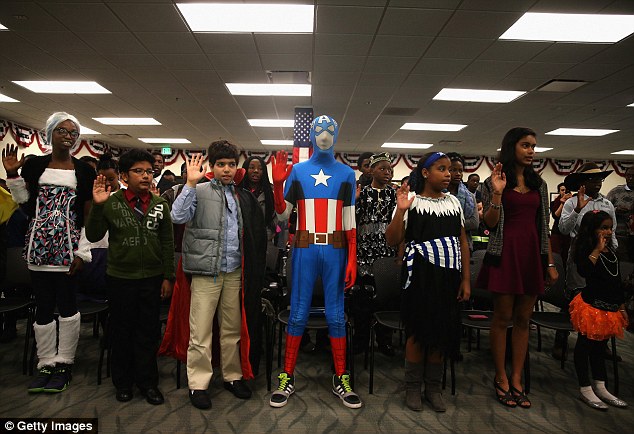
Voting is the only thing about which I am an absolute evangelical. It is America’s strongest and most enduring characteristic and the thing that, despite everything, still compels foreigners to emigrate. It is undeniably the most patriotic act an American citizen can perform. It is why 13-year-old Erza Retta Dessie from Ethiopia wore a Captain America costume when he got sworn in as an American citizen four days ago. The greatest gift I got while I was an international election monitor was understanding the power of the ballot box. You can’t change anything without participation.
Tired of corruption? Vote. Think politicians can’t be trusted? Vote. Want your guy or woman to win? Vote? Want any kind of change? Vote. Want to affirm the reasons why your forefathers came to this country? Vote. Want to affirm the assertion that people can change a nation? Vote.
Welcome to America, Captain.
See you at the polling place. (Not sure where it is? Look it up here.)
To motivate you, and in honor of the late departed Mr. Bradlee, a titan of the field of journalism, I give you the Washington Post March.
Oh Sharon Jones, you magnificent bastard. Every component of this song works together. It’s so tight. There isn’t any extraneous mess. That bass guitar, that bari sax…I’m having a hard time typing this…while standing up…and dancing…
Shameless Friend Promotion! Portia, aka Piz, is the best chef I know. If you want to try your hand at her kind of culinary mastery, boogie on over to Portia’s TurnTable.
Portia’s Justification:
Here’s an antidote to the ebola hysteria. “Every man, woman and child is catching it. It’s called the Dap Dip, and they say you get it in your pants.”
Fun 1970 live performance with the Kenny Clarke/Francy Boland Big Band in Denmark:
Yankette’s Reaction:
Oh now this is a sassy little number. It makes me wish for swingable hips, tossable hair, and a rooftop (or even a fire escape). God bless my wonderful K-Smash for picking this tune. It sounds kind of lounge-y but it doesn’t have the sleaze of 1950s or 1960s era lounge music, though it’s decidedly raunchy (those horns…dang). Thank the good Whomever for American culture that created this kind of music.
Shameless friend promotion! K-Smash, aka Kendra, is an absolutely phenomenal photographer. Should you ever need an A.P.P., give her a ring. http://kendrajoyphotography.com
Kendra’s Justification:
Tasked by our beloved Yankette with spreading the good word about a favorite jazz tune, I knew immediately I wanted to share my love of Afro-Cuban jazz. (We’re dipping a bit into tomorrow’s Worldly genre, but I’m calling the shots today, and I say it’s ok.)
“Manteca” – literally “lard” in Spanish, but used as slang for marijuana in Cuba – is one of the earliest tunes to weave Afro-Cuban influences into American jazz. (See, we didn’t dive head-long into the “Worldly” realm; we’re keeping at least one foot on American soil.) This tune, co-written by Dizzy Gillespie, Chano Pozo and Gil Fuller, is among the most famous of Gillespie’s recordings. Gillespie, who was introduced to Afro-Cuban music by trumpeter/composer Mario Bauza, added Cuban conguero Chano Pozo to his big band in September of 1947. Until Pozo’s untimely demise just over a year later, he made a lasting mark on both the jazz and Latin American music worlds; this tune was part of that legacy.
Though Gillespie made a concerted effort to mesh percussion-driven, rhythmically complex Afro-Cuban themes with passages more akin to the melodic and harmonic conventions of American jazz, early performances of “Manteca” revealed that despite their enthusiasm for collaborating, Gillespie and Pozo were quite unaccustomed to one other’s music. Gillespie’s band, for example, was unfamiliar with guajeos – syncopated phrasing common in Cuban music – and they overdid the swinging with atypical accentuation. As it turns out, complete assimilation of Afro-Cuban rhythms and American jazz improvisations was still a few years away for the beboppers in 1947.
Personally, this early stab at combining Cuban and American musical vibes takes me back to the Fall of 2005 when I – a young American girl with absolutely no dance skills – spent an evening dancing on a rooftop in Havana with a ridiculously attractive Afro-Cuban man. My hips, much like Gillespie’s band, were unfamiliar with the rhythms and moves which came so naturally to my newly-made Cuban friends. Nevertheless, I improvised, and we danced the night away. I hope this tune makes you want to get up and move, even if you’re not on a Havana rooftop sipping a mojito.
This song is so sweet! It sounds like it was written for (and by?) an awkward high-schooler. I love the rhythm, obviously. But, “if it’s not love, then it’s the bomb that will bring us together?” Well that’s different. Songs like this remind me that it’s so hard to find current pop songs that are this interesting and direct. The song sounds so happy but there is clearly a message here.
Iain’s Justification:
I love this song. It’s a study in abnormal black/white duality that intentionally ignores the gray middle ground. Moz starts the song by claiming that “shyness is nice” but immediately follows it with “shyness can stop you from doing all the things in life you’d like to” – is the implication that he likes it if you don’t do all the things in life you’d like to? The lyrics culminate in the chorus – “If it’s not love then it’s the bomb – the bomb – the bomb – that will bring us together.” Logically, that means that either love or a destructive, possibly deadly force that will bring us together; there’s no room for something like chemistry, luck, or penguins to draw us together. There’s love. Or there’s the bomb.
The song is filled with these black/white contradictions that ignore the middle ground – “spending warm summer days indoors” (wouldn’t the obvious choice be to be outdoors on a warm summer day?) or “ask me/I won’t say no/how could I?” (so it’s just yes or no, no partial answers).
The lyrics are typical Moz, but it’s also hard to not also be swept up in Johnny Marr’s exuberant guitar line. Marr has a sharp ear for hooks – as is also evident from his tenure with Modest Mouse, which moved that group into an even more radio-friendly, hook-heavy sound – so it is no surprise that his boisterous playing almost always turns Moz’s dark, twisty, and twisted lyrics into bouncy pop poems.
Why did I put this song forward? I don’t have any particular nostalgia for this song, it doesn’t bring up any particular emotions or past triumphs, and it isn’t because I am a lifelong fan of the Smiths – I got into the group quite late, actually. I circled off this song multiple times, but it always came back. I thought about Trampled by Turtles’ “Keys to Paradise,” maybe something from Tanya Donelly for the Yankette (can’t get much more New England than the Throwing Muses and its offshoots), or even the Beatles. But the Smiths’ “Ask” is just such a phenomenal song – and a bastard of an earworm at that – that I had to put it forward. (And yes, I’m cheating by linking to other songs I considered, but I live to cheat. Well, unless it’s a standardized test that requires a scan of the veins in my hand in order to even enter the testing room.)
One of my dearest friends in DC got hitched last week and tonight is her wedding reception. This song has been running through my mind as I went shopping for a suitable present.
The author of a book I read years ago described jet lag as a soul, on a tether to the physical body, making its way back home after the body has traveled too far, too fast. That may or may not explain why I’ve felt slightly catatonic all day today, and why this post is so late. Another explanation is a deep sense of contented stability brought about from returning to a good life that I have worked hard to create. Either/or.
Tehillim, pronounced “the-hill-leem,” are psalms. Reich wrote these pieces in 1981. The words of part one are taken from Psalm 19:1-4: “The heavens declare the glory of God; and the firmament sheath his handiwork. Day unto day uttereth speech, and night unto night sheath knowledge.” The second part, which begins at 11:31, is Psalm 34:13-15, whose words are: “Keep your tongue from evil, and your lips from speaking deceit. Depart from evil and do good; Seek peace and pursue it. The eyes of the Lordare on the righteous, and His ears are open to their cry.”
These pieces just make me so very happy. If you’d like to know more about this music, this is a really interesting interview with Reich about the Tehillim in which he talks about what it was that caused him to compose these pieces. It’s wonderful.

 The Daily Tune-Up