Have you ever had any of the following thoughts?
* Get me out of here.
* Nope nope nope nope nope nnnnnope.
* Oh please, sweet mercy, shut up.
* Is death imminent, and if not, how soon can it get here?
* Perhaps I should practice my breathing techni–oh f%&* my breathing technique.
* I wonder whether the Department of Transportation is hiring. I like being outdoors and standing around with shovels. Why didn’t I ever pursue my dream of being on a road crew?
* What objects currently within reach could I use to break the window and shimmy down the side of this building to freedom?
* If I sold all of my possessions and liquidated my assets, I could buy a shiny Airstream Trailer and drive around the country. Maybe I’d make puppets. I like puppets. Why didn’t I ever pursue my dream of being a nomadic puppeter…puppetist…puppet-mast–no that’s the horror movie…puppeteer?
* How many holidays do I have to spend with her family before I convince her I like them fine and I never have to see them again?
* Her brother, though. Jesus.
* I wonder if I can out-swim a shark.
None?
Oh okay. Well you can wait until Thursday. Peace out.
Oh, Fever Ray. You’re so incredibly weird. Is it because you’re Swedish? Do I really care? No, not really. For other, darker songs, check out “Keep The Streets Empty For Me,” and “Seven.”
PS: Whoopsidaisie, I let the blog lie fallow for a week. Sorry, Yankette Nation.
I marked my 23rd birthday while monitoring the second round of presidential elections in Boghe, Mauritania. I remember so many things about that day. I remember the delay on the satellite phone I used to call my parents during a lunch break. I remember the uneven wooden benches we sat on as we watched hundreds of people file into concrete block schoolhouses, present their I.D. cards, be handed a ballot, go behind a cloth screen, make their choice, stuff their ballot in a plastic bin, dip their finger into an ink bottle, and walk out. Person, after person, after person; men, women, and new-to-voting teenagers. I remember watching an argument between an election official and a woman who had walked twenty miles to vote but had forgotten her identification. I remember watching the vote count, late into the night. I remember being amazed at how fervently people wanted to vote. I remember wishing my country was similar. I remember Mauritanians asking me why it wasn’t.
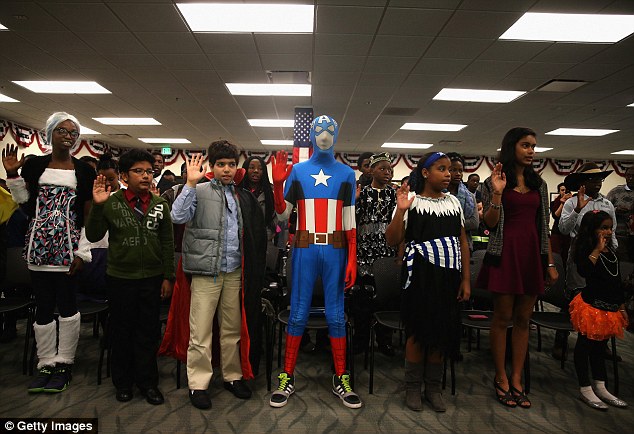
Voting is the only thing about which I am an absolute evangelical. It is America’s strongest and most enduring characteristic and the thing that, despite everything, still compels foreigners to emigrate. It is undeniably the most patriotic act an American citizen can perform. It is why 13-year-old Erza Retta Dessie from Ethiopia wore a Captain America costume when he got sworn in as an American citizen four days ago. The greatest gift I got while I was an international election monitor was understanding the power of the ballot box. You can’t change anything without participation.
Tired of corruption? Vote. Think politicians can’t be trusted? Vote. Want your guy or woman to win? Vote? Want any kind of change? Vote. Want to affirm the reasons why your forefathers came to this country? Vote. Want to affirm the assertion that people can change a nation? Vote.
Welcome to America, Captain.
See you at the polling place. (Not sure where it is? Look it up here.)
To motivate you, and in honor of the late departed Mr. Bradlee, a titan of the field of journalism, I give you the Washington Post March.
This band is a new discovery for me, and I’m more than a little obsessed with this song. The group is from Canada and makes music that is as expansive and beautiful as the country itself. My cousin compared the banjo to the telephone poles that pin a highway to the earth. Since this song sounds like a high-speed yet solo car journey, I think he’s exactly right.
Oh, stick a fork in me. This piece might – might – be more fun to sing than listen to, but nevertheless, it’s a sucker-punch. It starts so mildly, but by the end, you’re completely wrung out. It’s a masterwork.
Shameless friend promotion! Sara is the best singer I have ever sung with, in my life, ever, and probably always will be. She also happens to be an astoundingly cool person. So listen to her singing and then put her in any and every musical production you have going. Trust me.
Sara’s Justification:
Here is Edgar Bainton’s “And I saw a new heaven.” If you’re Anglican you’ve probably heard it; if you’ve been involved in church music at all you’ve most likely sung it. I am of the opinion that most British choral music that has stood the test of time is pretty darn good, but I don’t think I’m alone in thinking that this anthem might be the best one ever. It’s written in the same lush late-romantic style as pieces by Bainton’s better-known contemporaries, like Vaughan Williams, but what I think makes this one so special is that it doesn’t draw on any of Vaughan Williams’ sensible British folksiness. There is a sense throughout the anthem – in both its dynamic and textual heights and most hushed moments – of an otherworldly ecstasy that cannot be matched in the rest of the choral repertoire from this period. Listening bliss. Enjoy!
Oh boy oh boy oh boy. I am such a RVW fangirl. The chord progressions he wrote open up a new dimension for me. It’s like the voice of the divine. It sounds very, very old but still vibrant. The “Fantasia” is the quintessential example of this. I will never forget the first time I heard it. I was driving in the car with one of my parents, probably my Dad, and it came on the radio. I was so entranced it was like I could see the music. It was so beautiful, it hurt. This is another one of those pieces that, for me, identifies and magnifies whatever mood I’m in. It is a magical piece.
Karl’s Justification:
Most classical music enthusiasts, or so I imagine, carry around in their heads at least a few names on a list of favorite composers who we believe are not as widely appreciated as they deserve to be. (If you are fortunate, this is balanced by a list of composers who aren’t as great as everyone else seems to think, since shunning the overrated ones helps offset the expense of buying CDs of the works by the people in the underappreciated group.) My roster for the first category is alas much longer than for the second, and right at the top sits Ralph (remember it rhymes with “safe”) Vaughan Williams (1872-1958), Britain’s greatest symphonist.
Vaughan Williams wrote a plethora of wonderful music over the course of more than sixty years, but among it all his most enduringly beloved work is this one. There are very few compositions anywhere in the vast Western concert repertoire that surpass the sublime Tallis Fantasia for sheer beauty. It is neither ornamental nor ramblingly mystical, but both transcendental and sensible in a way that C. S. Lewis might be able to describe. Even after having sifted through dozens of renditions of this piece over the past few days while selecting a video for this post, when played well it still gives me chills.
This performance, conducted by Sir Andrew Davis, was recorded in Gloucester Cathedral, the location for which the young RVW composed the Fantasia and where he conducted the premiere of the original version in 1910 (though they presumably didn’t play it in the dark on that occasion). While the direction of this video brings to mind Fred Astaire’s declaration early in his film career that “either the camera will dance or I will,” it aptly demonstrates the peculiar ensemble called for by the composition: a string orchestra, a quartet, and an additional group of players ideally to be seated well away from the others (often positioned in an upper gallery in performances in churches or halls so equipped). If the incessant crane and dolly shots in this video drive you crazy, there are literally hundreds of other recordings of the piece on YouTube, thanks in part to its popularity among high school and university orchestra directors.
The theme of the Fantasia comes from this tune by the incomparable Thomas Tallis, which appeared in Archbishop Parker’s Psalter of 1567
I know it’s a bit outré to use a video clip from a TV show, but hear me out. Click the second link below first before you watch the clip. The Morehouse College Glee Club sings the song masterfully. The harmonies are tight and the dynamics are powerful.
Now click on the video clip. It’s an entirely different song now. Using it as the song the railroad workers sing as they hammer the nails into the track – singing a song about building a home as they’re building the railroad – is genius, and very moving. The clip is from the TV show, “Hell on Wheels,” which is about the creation of the Union Pacific railroad after the Civil War. By and large, the men working on the railroad are (very recently) freed slaves. The rest are immigrants from Ireland and settlers from the rest of the country. Together they are building the railroad that will knit the country, torn in two by the war, back into one nation – a new home for everyone. The first sharp clang of the hammer on the nail is a wonderful moment. The rest of the scene shows the protagonist of the story, Cullen Bohannon, a former soldier in the Confederate army who has sought a kind of redemption in spearheading the construction of the Union Pacific, being led to a Mormon camp to answer for a crime he committed. The Mormons, too, are building a home for themselves in the new country. To have this song running through this scene that shows all of these different groups joined by the same goal…it’s pretty powerful.
Tehillim, pronounced “the-hill-leem,” are psalms. Reich wrote these pieces in 1981. The words of part one are taken from Psalm 19:1-4: “The heavens declare the glory of God; and the firmament sheath his handiwork. Day unto day uttereth speech, and night unto night sheath knowledge.” The second part, which begins at 11:31, is Psalm 34:13-15, whose words are: “Keep your tongue from evil, and your lips from speaking deceit. Depart from evil and do good; Seek peace and pursue it. The eyes of the Lordare on the righteous, and His ears are open to their cry.”
These pieces just make me so very happy. If you’d like to know more about this music, this is a really interesting interview with Reich about the Tehillim in which he talks about what it was that caused him to compose these pieces. It’s wonderful.
This is your intrepid Yankette, coming to you from lovely Los Angeles. I managed to get a wicked cold in Hawaii so I’m more or less running on fumes, caffeine, and Tylenol this week. But with the help of my buddies AC/DC, I’ll get it done.

 The Daily Tune-Up